

If you are considering a career in electrical work, understanding electrician license requirements is one of the first steps. Every state regulates electrical work differently, but most follow a similar path that includes training, experience, and passing an exam.
Knowing what to expect helps you plan your career, avoid delays, and move toward becoming a licensed professional. This guide breaks down education paths, testing requirements, and costs so you can see how the process works.
Why Electrician License Requirements Matter
Electrical work affects safety in homes, businesses, and public buildings. Because of that responsibility, most states require electricians to meet specific training and licensing standards.
These requirements help ensure electricians understand electrical systems, building codes, and safety procedures. Licensing also helps protect customers and businesses by confirming that workers meet professional standards.
Across the United States, electricians are in steady demand. According to the U.S. Bureau of Labor Statistics, employment for electricians is projected to grow about 9 percent through 2034, which is faster than the average for many occupations.
That demand creates opportunities for people entering the trade. Understanding electrical license requirements by state helps you see the path ahead and decide where you want to work.
Electrician License Requirements Across the United States
While each state sets its own rules, most follow a similar structure. Electricians typically move through three levels of licensing:
- Apprentice electrician
- Journeyman electrician
- Master electrician
Most states require thousands of hours of supervised work before you can apply for higher licensing levels. For example, many journeyman licenses require about 8,000 hours of practical work experience, which is usually completed during an apprenticeship. Even though the exact rules vary, the overall progression remains similar nationwide.
How to Get Licensed as an Electrician
Most electricians follow a similar path as they work toward getting licensed.
Step 1: Complete Basic Education
The first step is usually a high school diploma or a GED. Basic math, science, and problem-solving skills are important in electrical work.
Many aspiring electricians attend technical schools or community college programs to learn the fundamentals of electricity. These programs often cover:
- Electrical theory
- Wiring systems
- Safety procedures
- Blueprint reading
Technical training can make it easier to find an apprenticeship and learn the trade more quickly.
Step 2: Start an Apprenticeship
Apprenticeships combine classroom learning with real-world job-site experience. Apprentices work under licensed electricians while learning the trade.
Most apprenticeships last four to five years. During this time, you gain thousands of hours of practical training.
Many apprenticeships are offered through:
- Trade unions
- Electrical contractors
- Trade associations
- Technical schools
Step 3: Meet Electrician Certification Requirements
After completing apprenticeship training, you may apply for the next level of certification. These electrician certification requirements usually include:
- Documented work experience
- Completion of classroom training
- Passing a licensing exam
At this point, you may qualify to work as a journeyman electrician in many states. Journeyman electricians can typically work independently, though they may still report to a master electrician or contractor depending on local regulations.
Electrician License Exam
Passing the electrician license exam is one of the most important steps in the process.
Most exams test your knowledge in areas such as:
- Electrical code and safety standards
- Wiring systems and installations
- Circuit calculations
- Electrical theory
Many states base their exam content on the National Electrical Code (NEC). The test format varies by state, but it often includes multiple-choice questions and practical problem-solving scenarios.
Preparing for the exam typically involves reviewing electrical codes, studying training materials, and taking practice tests.
How Long Does It Take to Get an Electrician License
The process usually takes several years because of the required work experience.
A typical timeline looks like this:
- 0 to 1 year: Technical training or trade school (optional but helpful)
- 4 to 5 years: Apprenticeship training and supervised work
- Final step: Licensing exam and application
In total, many electricians become licensed journeymen after about four to six years of combined education and work experience. While this may seem like a long path, the advantage is that apprentices earn wages while training.
Electrician License Cost
The electrician license cost varies depending on the state and the level of licensing you pursue.
Common costs include:
- Application fees
- Exam fees
- Licensing fees
- Study materials
- Continuing education courses
In many states, licensing costs range from $50 to $300 for exams and applications combined. Training programs and tools can increase total costs, especially during the early years of a career. Some apprenticeships help cover training expenses, thereby reducing upfront costs.
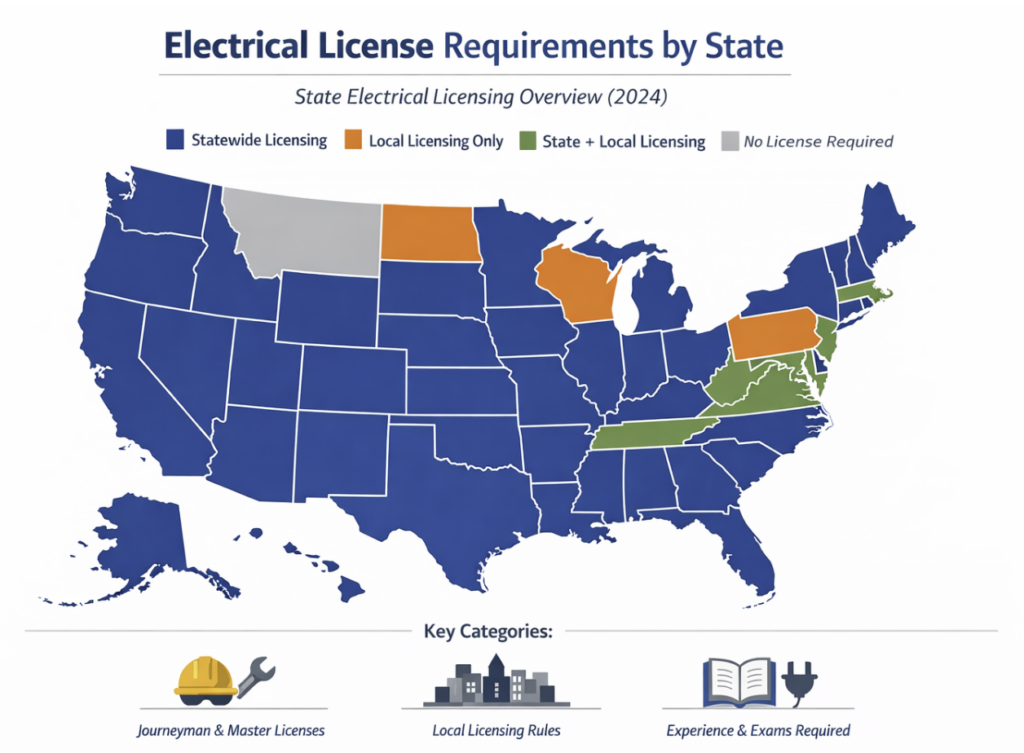
Electrical License Requirements by State
Although the licensing process follows a similar structure nationwide, each state sets its own rules for training, exams, and licensing levels.
Electrical License Requirements by State (All 50 States)
| State | Licensing Authority | License Structure | Local Licensing? | Official Resource |
| Alabama | Electrical Contractors Board | Journeyman, Contractor | No | https://aecb.alabama.gov |
| Alaska | Dept. of Labor | Apprentice, Journeyman, Admin | No | https://labor.alaska.gov |
| Arizona | Registrar of Contractors | Residential/Commercial Contractor | No | https://roc.az.gov |
| Arkansas | Dept. of Labor & Licensing | Journeyman, Master | No | https://www.labor.arkansas.gov |
| California | CSLB / DIR | General Electrician, Contractor | No | https://www.cslb.ca.gov |
| Colorado | DORA | Residential, Journeyman, Master | No | https://dpo.colorado.gov |
| Connecticut | Dept. of Consumer Protection | Journeyman, Contractor | No | https://portal.ct.gov/DCP |
| Delaware | Division of Prof. Regulation | Journeyman, Master | No | https://dpr.delaware.gov |
| Florida | DBPR | Certified / Registered | Yes | https://www.myfloridalicense.com |
| Georgia | Licensing Board | Class I & II | No | https://sos.ga.gov |
| Hawaii | Contractors License Board | Supervising, Journey Worker | No | https://cca.hawaii.gov |
| Idaho | Division of Building Safety | Apprentice, Journeyman, Master | No | https://dbs.idaho.gov |
| Illinois | Local jurisdictions | Varies | Yes | https://idfpr.illinois.gov |
| Indiana | Local | Varies | Yes | https://www.in.gov |
| Iowa | Electrical Examining Board | Apprentice, Journeyman, Master | No | https://plb.iowa.gov |
| Kansas | Local | Varies | Yes | https://www.ks.gov |
| Kentucky | Dept. of Housing | Electrician, Master | No | https://dhbc.ky.gov |
| Louisiana | State Licensing Board | Journeyman, Contractor | No | https://lslbc.louisiana.gov |
| Maine | Electricians’ Exam Board | Journeyman, Master | No | https://www.maine.gov |
| Maryland | Dept. of Labor | Master Electrician | Yes | https://www.dllr.state.md.us |
| Massachusetts | Board of Electricians | Journeyman, Master | No | https://www.mass.gov |
| Michigan | LARA | Journeyman, Master, Contractor | No | https://www.michigan.gov/lara |
| Minnesota | Dept. of Labor | Journeyman, Master | No | https://www.dli.mn.gov |
| Mississippi | State Board of Contractors | Electrical Contractor | No | https://www.msboc.us |
| Missouri | Local | Varies | Yes | https://pr.mo.gov |
| Montana | Dept. of Labor | Journeyman, Master | No | https://erd.dli.mt.gov |
| Nebraska | State Electrical Board | Journeyman, Contractor | No | https://electrical.nebraska.gov |
| Nevada | Contractors Board | C-2 Electrical Contractor | No | https://www.nvcontractorsboard.com |
| New Hampshire | Electricians Board | Journeyman, Master | No | https://www.oplc.nh.gov |
| New Jersey | Board of Examiners | Electrical Contractor | No | https://www.njconsumeraffairs.gov |
| New Mexico | Regulation & Licensing | Journeyman, Contractor | No | https://www.rld.nm.gov |
| New York | Local (NYC Dept. of Buildings) | Varies | Yes | https://www.nyc.gov/site/buildings |
| North Carolina | Electrical Board | Limited, Intermediate, Unlimited | No | https://www.ncbeec.org |
| North Dakota | State Electrical Board | Journeyman, Master | No | https://www.ndseb.com |
| Ohio | Construction Licensing Board | Electrical Contractor | No | https://com.ohio.gov |
| Oklahoma | Construction Industries Board | Journeyman, Contractor | No | https://cib.ok.gov |
| Oregon | Building Codes Division | General, Limited | No | https://www.oregon.gov |
| Pennsylvania | Local | Varies | Yes | https://www.dli.pa.gov |
| Rhode Island | Dept. of Labor | Journeyman, Master | No | https://dlt.ri.gov |
| South Carolina | Labor Licensing Board | Residential, Commercial | No | https://llr.sc.gov |
| South Dakota | Electrical Commission | Journeyman, Contractor | No | https://dlr.sd.gov |
| Tennessee | Contractors Board | Electrical Contractor | No | https://www.tn.gov |
| Texas | TDLR | Apprentice, Journeyman, Master | No | https://www.tdlr.texas.gov |
| Utah | DOPL | Journeyman, Master | No | https://dopl.utah.gov |
| Vermont | Division of Fire Safety | Journeyman, Master | No | https://firesafety.vermont.gov |
| Virginia | DPOR | Journeyman, Master, Contractor | No | https://www.dpor.virginia.gov |
| Washington | Labor & Industries | Trainee, Journeyman, Master | No | https://www.lni.wa.gov |
| West Virginia | Fire Marshal | Journeyman, Master | No | https://firemarshal.wv.gov |
| Wisconsin | Dept. of Safety | Journeyman, Master | No | https://dsps.wi.gov |
| Wyoming | Fire Prevention Dept. | Journeyman, Master | No | https://wsfm.wyo.gov |
California requires electricians working on certain construction projects to be certified by the state through the California Department of Industrial Relations. Applicants must complete approved training or work experience and pass a certification exam based on the National Electrical Code.
In Texas, the Texas Department of Licensing and Regulation offers several license levels, including residential wireman, journeyman electrician, and master electrician. Each level requires a specific number of work hours and passing a state licensing exam.
Florida requires electrical contractors to obtain either a certified or registered contractor license, which involves meeting experience requirements and passing business and technical exams administered by the state.
Other states have different structures. New York, for example, does not issue a statewide electrician license. Instead, many cities and counties manage their own licensing systems.
In Illinois, most licensing requirements are handled locally as well, though electricians working in certain jurisdictions must pass exams and meet experience requirements before receiving approval to operate.
Check Your Local Licensing Authority
Before you apply, confirm whether your area uses state, city, or county licensing rules. Review the required work hours, exam details, application fees, and renewal steps for that location. Some boards also list approved apprenticeship paths or accepted classroom training. Starting with the correct licensing office helps you follow the right process from the beginning.
Skills That Help You Succeed as an Electrician
Technical knowledge is essential, but successful electricians also develop strong practical skills.
These include:
- Attention to detail
- Problem-solving ability
- Communication with customers
- Time management on job sites
Many electricians eventually move on to run their own service businesses. At that stage, organization and scheduling become just as important as technical ability. Some contractors use field service platforms like Service Fusion to manage job scheduling, dispatching, and customer communication as their businesses grow.
Building a Career After Getting Licensed
After becoming licensed, electricians have several career paths available to them. Some electricians work for electrical contractors or construction companies. Others focus on residential service, maintenance, or commercial electrical work. Experienced electricians may eventually open their own electrical service companies.
When running an electrical business, managing appointments, tracking jobs, and communicating with customers become part of daily work. Platforms like Service Fusion help many service companies organize scheduling and job information in one place as their operations expand.
Planning for Long-Term Growth in the Electrical Trade
The electrical field offers steady career opportunities and the chance to build specialized skills over time.
Some electricians focus on areas such as:
- Renewable energy installations
- Electric vehicle charging systems
- Smart home technology
- Industrial electrical systems
As technology changes, demand for skilled electricians continues to grow. Building experience and maintaining licensing credentials can open new opportunities throughout your career.
If you eventually start your own electrical company, tools like Service Fusion can help organize scheduling, service calls, and customer records so your team can stay focused on delivering quality work.
Taking the First Step Toward an Electrical Career
Understanding electrician license requirements helps you see the path to a stable, rewarding trade career. Most electricians begin with education, complete an apprenticeship, and pass a licensing exam before working independently. Although the process takes several years, you gain real job experience while learning the trade.
If you plan to grow your electrical business over time, get a free demo to see how Service Fusion can help you manage scheduling, jobs, and customer communication in one place.
Related Posts
Best Field Service Software for Businesses With 5 to 20 Technicians (2026)
Continue ReadingField Service Software Data Migration Checklist
Continue ReadingStay Informed
Get the latest news and insights plus, Service Fusion offers and updates.Thank you for your submission.
SHARE