


If you own or manage a small- or medium-sized HVAC business, you’ve probably established a roster of regulars. Returning customers are essential to any business, but for growth, you need to attract new ones, too. But how do you go about doing that?
This guide breaks down how to grow your heating and air conditioning business profitably, from pricing and recurring revenue to hiring, systems, and building a company that’s worth more. It also shows where Service Fusion’s HVAC software fits as you add techs and trucks to your fleet.
Quick Answer: How Do You Grow an HVAC Business?
Broadly speaking, growing an HVAC business involves pricing every job for profit, keeping your existing customers, hiring and retaining good technicians, marketing for the jobs you want, putting systems in place before adding trucks, and reviewing a few key performance indicators (KPIs) every month.
Each step protects the one after it.
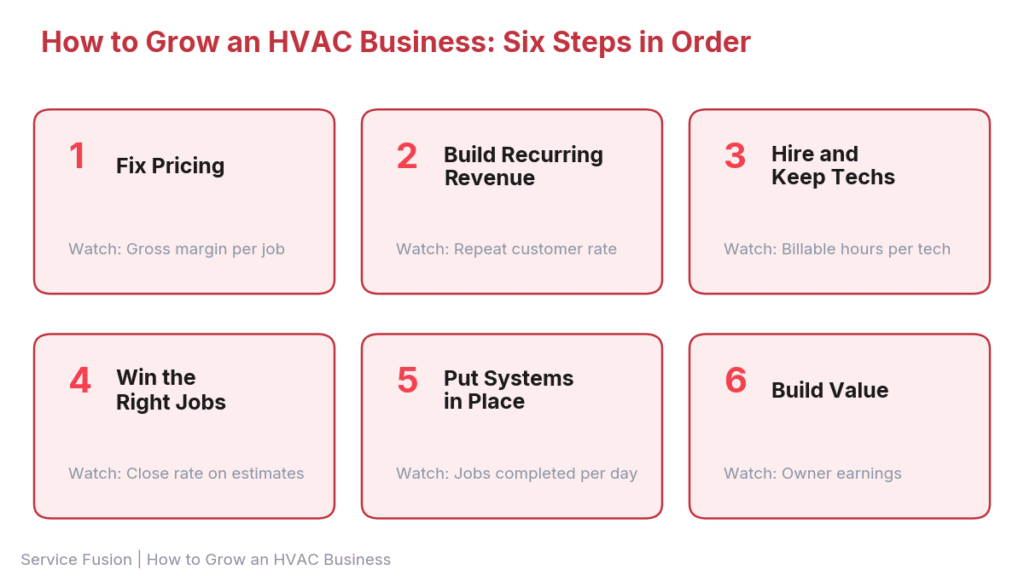
1. Fix Pricing First
Rebuilding your pricing ensures you’re accounting for your true labor costs, the latest parts prices, overhead, and target margin. Only then can you be sure that growth increases profit, not just work.
This step is non-negotiable, especially when contractor margins are this thin.
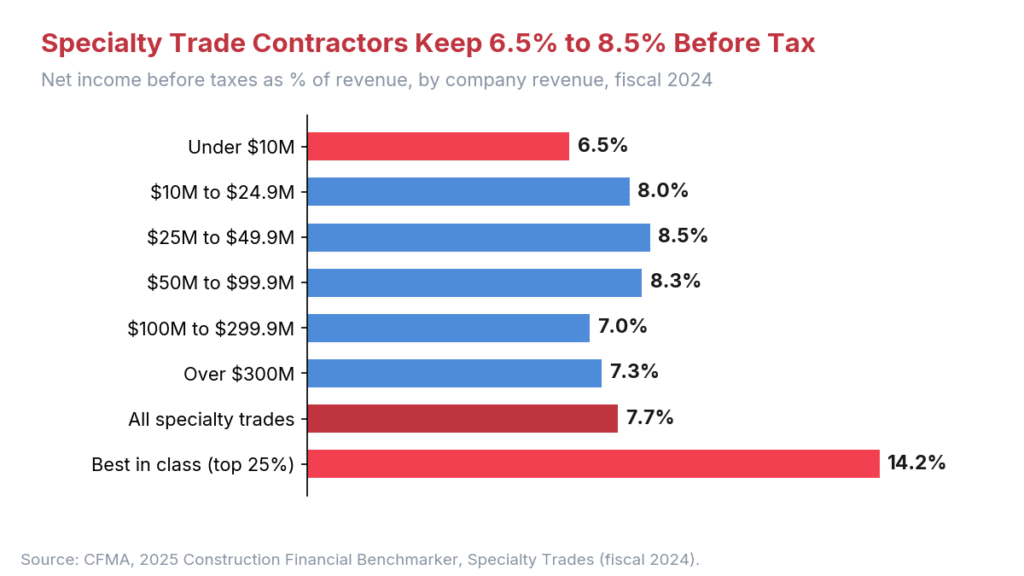
Specialty trade contractors, a group led by plumbing, heating, and air-conditioning firms, reported average net income before taxes of 7.7% of revenue in 2024, or 6.5% for firms under $10 million in revenue.[1] Margins vary by size, and the best-performing quarter of specialty contractors reached 14.2%.[1]
RELATED READING: How to Price HVAC Jobs: A Step-by-Step Guide
| Worked example: A shop with $1 million in revenue and a 6.5% net margin makes $65,000 in profit. If it raises prices by 5% while keeping the number of jobs and costs unchanged, revenue rises to $1.05 million and profit to $115,000. That 5% price change lifts profit by 77%. Raising your average ticket has a similar effect. Offering repair-or-replace options and quoting add-ons the customer actually needs lifts revenue per call without adding a truck. NOTE: This hypothetical scenario assumes job volume and costs stay the same. |
Price every job for profit with the HVAC Bid Calculator.
2. Build Recurring Revenue

All things being equal, it’s cheaper and more efficient to keep existing customers happy
Recurring revenue comes from customers who call you back every season instead of searching for someone new. Follow up after every job, offer seasonal service, and make it easy to book again.
There are two key foundational blocks for any HVAC business, and they are related.
- Your existing customers.
- New business.
How are they intertwined? Regular customers are your best source of free word-of-mouth advertising. When they refer you to friends and family, you bring in new clients.
To get those coveted referrals, you need to keep your existing customers happy.
Winning a new customer usually costs more than keeping one you already have, and small gains in retention add up. Bain & Company found that in financial services, a 5% increase in customer retention produced more than a 25% increase in profit, because returning customers buy more over time, cost less to serve, and refer others.[2]
So, how do you retain existing HVAC customers? Here are some tried-and-true strategies you can start using immediately:
- Follow up after providing a service to ensure everything is to the customer’s liking. A quick phone call three to five days later shows you want to make sure they’re satisfied.
- Develop new services for regulars, like seasonal maintenance checks or winterizing. Offer these at an exclusive price for valued customers.
- Offer a service plan so customers have a reason to book with you every season, and you have steadier work in the shoulder months.
- Keep equipment history on file so the next tech knows the system’s age, past repairs, and what to recommend.
3. Hire and Keep Good Techs
You can’t grow faster than you can staff, so you’ll need to hire proactively. For instance, you can plan hires before peak season, pay at or above the local market rate, and give techs a clear path to grow.
Remember, keeping a good tech costs less than replacing one, especially in a tight labor market.
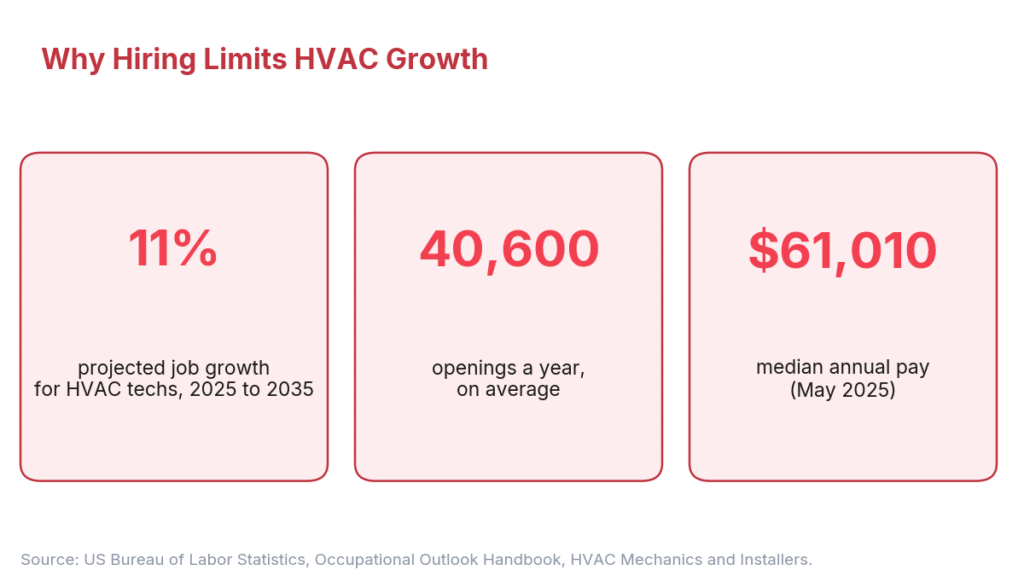
The Bureau of Labor Statistics (BLS) projects HVAC technician jobs to grow 11% from 2025 to 2035, much faster than the average for all occupations, with about 40,600 openings each year. The median HVAC technician earned $61,010 in May 2025.[3]
To hire and keep the techs you need:
- Hire ahead of the season: Recruit in the shoulder months, when you have time to train.
- Know your market rate: Benchmark pay against the BLS median and local job listings, and remember that what a tech costs you is more than their wage.
- Show a career path: Apprentice to lead tech to service manager gives people a reason to stay.
- Onboard properly: A structured first 90 days gets new techs billing sooner.
- Give techs good tools: Reliable trucks, equipment, and a mobile app that shows job history cut wasted time on site.
RELATED READING: How to Attract and Retain the Best HVAC Employees
4. Win More of the Right Jobs
True HVAC business growth means winning the jobs that fit your margins and your team, not just servicing more calls. Know what sets you apart, earn reviews on every job, build referral partnerships, and offer the services your existing customers already need.
Develop Your USP
You want to identify your unique selling proposition (USP) so you can use it to stand apart from your competition. Maybe you are the best at converting apartments to heat pump technology. Perhaps you want to emphasize your expertise as a green, eco-friendly consultant.
Ask for Online Reviews

Whenever you finish a job with a customer, ask them to post a review online.
According to BrightLocal, 97% of consumers read reviews for local businesses.[4]
After every job, gently remind your customers to drop an honest review of your services online. For example, you can text or email a reminder with a link to where you want them to post their review.
If a customer posts a negative review, don’t ignore it. Reply quickly so the public can see you’re responsive. Offer to fix the problem at no additional cost if the error was made on your part. This helps maintain your online reputation and shows you stand behind your work.
Build Referral Partnerships
One of the best ways to get new customers is to network with other non-competitive professionals in your area. Some businesses that might need HVAC assistance include:
- Property managers
- Real estate agents
- New home construction companies
- Renovators and remodelers
- General contractors and handyman services
- Electricians and plumbers
- Green energy and solar specialists
- Hotels and motels
- Apartment managers.
You can offer referral clients from your network a discount or perk to sweeten the deal.
Expand Your Services
You’re probably already providing the basics, like repair and installation. Specialized services can set you apart and sell more to customers you already have:
- Smart home technology for comfort and safety
- Indoor air quality improvement and monitoring
- Sustainable and energy-efficient HVAC solutions.
Heating and cooling emergencies rarely happen during banker’s hours. Consider adding emergency coverage if you don’t already offer it. You can add an emergency surcharge for last-minute appointments after hours to make up for the inconvenience.
For website, SEO, and advertising tactics, see our guides on how to get more customers for your HVAC business and how to market your HVAC business.
5. Put Systems in Place Before Adding Trucks
Every new truck in your fleet adds calls, schedules, invoices, and customer records. If those live on paper, in spreadsheets, and in memory, the office breaks down before the field does. A good rule of thumb is to migrate your scheduling, dispatch, estimates, and invoicing processes into one system first, then add capacity.
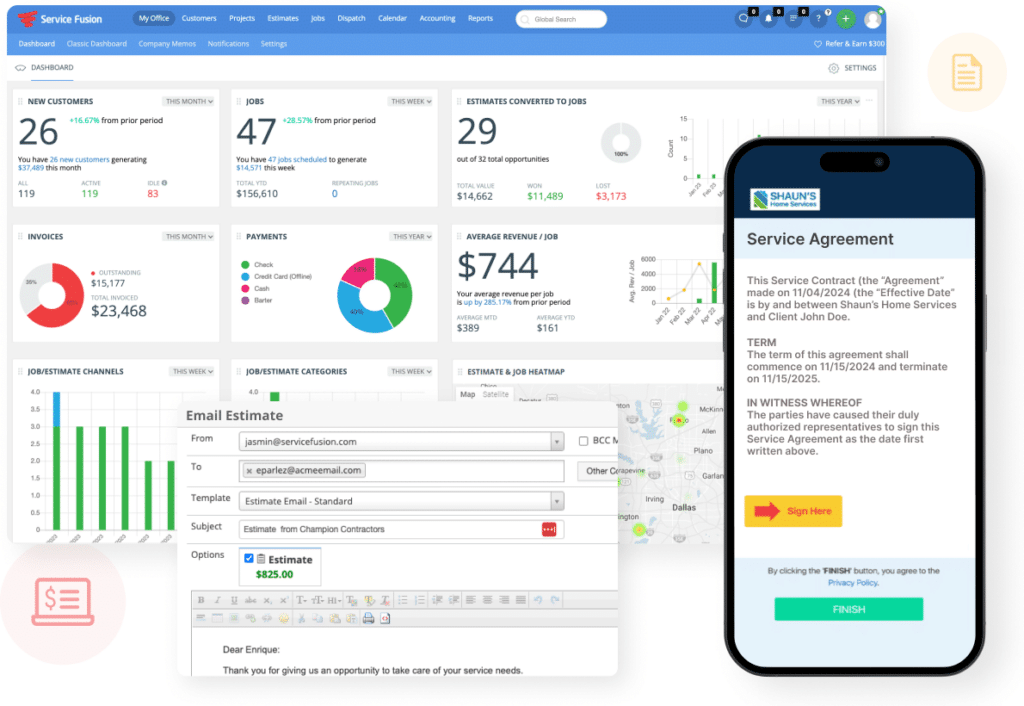
HVAC Service Software from Service Fusion supports on-the-go operators from the field to the office
This is where HVAC business management software like Service Fusion comes in, helping you organize and automate tasks such as:
- Tracking your fleet, including fuel costs and truck rolls
- Managing customer calls and client histories
- Streamlining invoicing and payment processes
- Organizing referrals and sales leads
- Creating and sending estimates.
Here’s a good question to ask when thinking about expansion: If you were off for two weeks, could the office schedule, dispatch, and bill without calling you? If not, fix that before adding the next truck.
RELATED READING: HVAC Business Management 101: 9 Key Concepts
6. Track the Numbers That Show Growth
Revenue alone doesn’t show whether you’re growing well. Track revenue alongside margin, average ticket, repeat customers, and billable hours every month, so you can spot problems early and see which growth moves are working.
When you set growth goals for your HVAC business, make them specific and measurable. Don’t use vague goals like “get more customers.” Instead, set a goal like “increase revenue by X% per month over the next 12 months.”
This way, it will be easier to measure results and track your performance. You can record your monthly revenue and look for upward trends that indicate progress.
You can also integrate revenue goals with other key performance indicators (KPIs) such as:
- Customer retention
- New customers obtained
- Operating costs
- Average sale amount
- Gross margin per job
- Job time and response
- Customer satisfaction
- Billable hours.
Get in the habit of tracking KPIs and goal milestones regularly. It will allow you to course-correct quickly if you’re not meeting milestones toward larger goals.
RELATED READING: How to Track Technician Performance: KPIs Every Service Business Should Measure
7. Build a Business That Is Worth More
A growing HVAC business should also be worth more. Buyers pay for earnings they can count on: steady service revenue, a team that runs without the owner, documented processes, and clean books. Every improvement that raises owner earnings also raises what the business could sell for.
Small HVAC businesses are usually valued as a multiple of owner earnings, also called seller’s discretionary earnings (SDE). In a sample of HVAC businesses listed for sale in the US, asking prices have a median of 2.8 times owner earnings and 0.62 times annual revenue, with a median asking price of $649,950.[5]
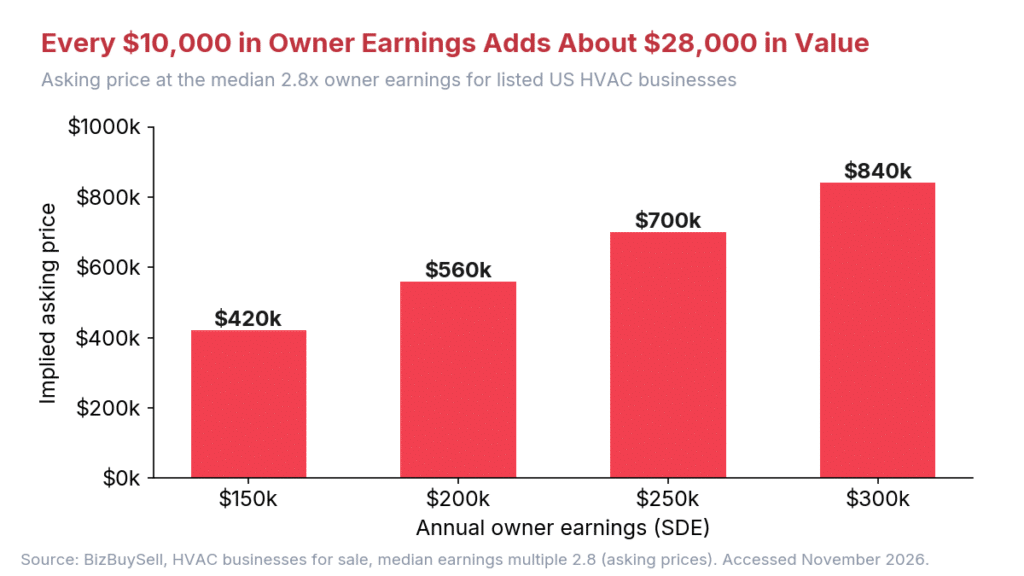
At that median multiple, every extra $10,000 in annual owner earnings adds about $28,000 to the asking price. Better pricing, more repeat work, and fewer wasted hours all feed directly into value.
To build value, focus on:
- Making the business run without you: Train a lead tech or service manager to handle daily decisions.
- Documenting how work gets done: Pricing, dispatch rules, and job checklists make the business easier to hand over.
- Keeping clean books: Buyers and lenders want verifiable earnings.
- Growing repeat service revenue: Predictable work is easier to value than one-off installs.
Estimate what your business is worth with the HVAC Business Valuation Calculator.
How to Grow an HVAC Business: FAQs
How do I grow my HVAC business?
Start with pricing, so every job makes money. Then keep your existing customers with follow-ups and seasonal service, hire ahead of demand, ask for reviews after every job, and put scheduling and invoicing systems in place before adding trucks. Track margin, average ticket, and repeat customers monthly.
Are HVAC businesses profitable?
They can be, but margins are thin. Specialty trade contractors, led by plumbing, heating, and air-conditioning firms, averaged 7.7% net income before taxes in 2024, and 6.5% for firms under $10 million in revenue.[1] Pricing and overhead control decide where your business lands.
How do I increase HVAC sales?
Raise your average ticket with repair-or-replace options, follow up on open estimates, ask every customer for a review, and build referral partnerships with property managers, real estate agents, and other trades.
When should I add another truck to my HVAC fleet?
When your current techs are consistently fully booked, your close rate is steady, and your office can schedule, dispatch, and invoice the extra work without the owner stepping in.
How much is my HVAC business worth?
A sample of listed HVAC businesses in the US shows a median asking price of 2.8 times owner earnings.[5] Your multiple depends on earnings, repeat revenue, and how well the business runs without you. The HVAC business valuation calculator gives a starting estimate.
Grow Your HVAC Business With the Right Systems
Growth adds jobs, people, and paperwork. With Service Fusion, you can keep scheduling, dispatch, estimates, invoicing, and customer history in one place, so your team can take on more work without the office falling behind. Book a demo now.
See How Service Fusion Supports a Growing HVAC Team
Article Sources
- Construction Financial Management Association (CFMA). 2025 Construction Financial Benchmarker: Executive Summary. Fiscal year 2024 data. Accessed November 10, 2026.
- Bain & Company. Fred Reichheld and Christine Detrick, Loyalty: A Prescription for Cutting Costs. Accessed November 10, 2026.
- US Bureau of Labor Statistics. Occupational Outlook Handbook: Heating, Air Conditioning, and Refrigeration Mechanics and Installers. Last modified August 27, 2026. Accessed November 10, 2026.
- BrightLocal. Local Consumer Review Survey 2026. February 2026. Accessed November 10, 2026.
- BizBuySell. HVAC Businesses for Sale: Valuation Multiples. Accessed November 10, 2026.
Related Posts
Must-Have Tools for HVAC Technicians
Continue ReadingHow Kuhlman Electric Found Their Field Service ‘Game Changer’ and Doubled Revenue
Continue ReadingStay Informed
Get the latest news and insights plus, Service Fusion offers and updates.Thank you for your submission.
SHARE