



Learning how to give great customer service as a contractor starts with one habit: keeping the customer informed. A missed callback or a technician who’s late with no warning can undo an otherwise well-done job. Good customer service in the trades mostly comes down to communication, making sure a customer never has to wonder what’s happening or when help is coming.
Key Takeaways
- Most customer service problems in the trades trace back to communication gaps.
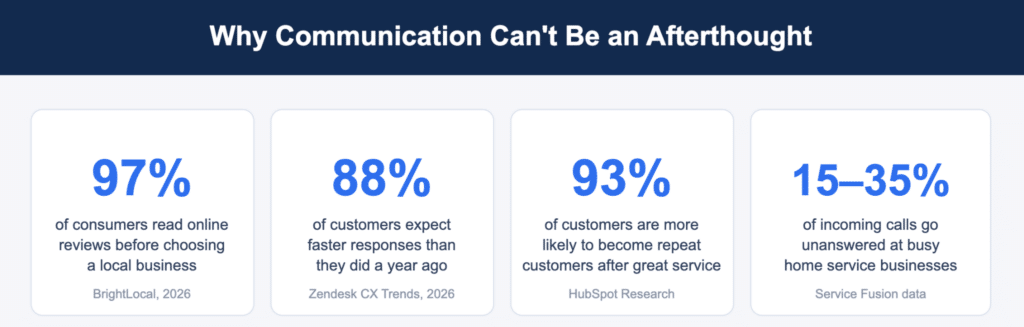
- 93% of customers are more likely to become repeat customers after excellent service (HubSpot)
- Setting expectations before the job starts prevents many complaints from happening
- Following up after every job, big or small, is what turns one-time customers into repeat ones.
- How you handle a complaint matters as much as whether one happens in the first place, because many customers will give a business a second chance after a mistake if the rest of the service is strong.
- Making yourself reachable by call, text, or chat is now a baseline expectation for most customers.
Quick Answer: How Can Contractors Improve Customer Service?
Contractors improve customer service by communicating clearly before, during, and after every job: setting expectations upfront, sending real-time updates like on-my-way texts and ETAs, following up once the work is done, and responding to complaints quickly and without getting defensive. Making it easy for customers to reach you by phone, text, or chat, and turning good experiences into reviews consistently, rounds out the basics. For most small service businesses, the difference is a repeatable communication process rather than a more complicated customer service program.
1. Set Clear Expectations Before the Job Starts
Most customer service complaints trace back to a mismatch between what the customer expected and what actually happened, like a vague arrival window. This estimate didn’t flag a possible extra cost, or even an explanation of what the visit would involve.
Before you arrive, confirm the appointment window, what the visit will cover, and roughly how much it will cost. If there’s a chance the job could turn into something bigger once a technician is on-site, say so upfront. Customers are much less likely to complain about a complication they were warned about in advance.
Setting expectations doesn’t stop once the technician is on-site and finds the actual problem. A diagnosis explained as “a burnt-out contactor causing single-phasing on your scroll compressor” means nothing to most homeowners, and jargon they don’t recognize tends to read as either an upsell or an exaggerated problem. Translating the issue into plain language and showing the customer the actual failed part whenever it’s safe to do so builds trust at exactly the moment a customer is deciding whether to trust the price they’re about to be quoted.
2. Keep Customers Updated While the Job Is Happening
Once you have more than a couple of jobs running a day, “we’ll be there sometime this afternoon” stops being good enough. GPS fleet tracking built into your field service software can send customers a real-time on-my-way text with their technician’s location and ETA, the same kind of live update customers are used to seeing in other parts of their day.
This cuts down on the “where’s my technician” calls that eat into your office team’s day, and it addresses a real shift in expectations. Zendesk’s 2026 CX Trends research found that 74% of consumers now expect round-the-clock service availability, and 88% expect faster responses than they did just a year ago. That shift applies to contractors too, even though the work happens in person.
Field service management software that keeps job status, technician assignment, and customer communication in one place makes this kind of update automatic rather than another thing for your office staff to remember.
3. Follow Up After Every Job
Learning how to follow up after a service call is one of the most skipped steps in the trades, usually because it feels unnecessary once the invoice is paid. It is also one of the easiest ways to catch a small problem before it becomes a bad review.
A short follow-up, a text or call a day or two after the job asking if everything’s working as expected, helps in two ways. First, it catches small issues while they’re still easy to fix for free. Second, it’s also usually the best moment to ask for a review, since the customer is still thinking about the job in a positive light.
The communication doesn’t need to be elaborate. A two-line text asking “Everything working well since Tuesday’s visit?” is often enough. That follow-up habit matters even more for customers on a recurring maintenance plan. A service agreement only holds up if the customer feels looked after between visits.
Related Reading: How Service Agreements Work in Service Fusion

4. How to Handle Customer Complaints Quickly and Professionally
Every contractor faces a tough client eventually. Whether it’s a genuine mistake or a simple misunderstanding, your response dictates what the customer remembers. People will give a business a second chance after a mistake, provided the rest of the experience holds up. A few habits make the difference:
- Acknowledge the Issue First: Customers want to feel heard before they hear an explanation.
- Respond Fast: A complaint that goes unanswered for three days feels like it is being ignored, even if you were planning to address it.
- Fix What is Fixable: Be honest, even about what’s not fixable. Overpromising a resolution you can’t deliver turns one complaint into two.
- Follow Up After the Fix: Confirm the resolution worked, and close the loop with the customer directly.
- Document the Complaint in the Customer Record: This gives your office and technicians context if the customer calls again and helps you spot recurring issues.
Complaints happen even in well-run businesses. A fast, clear response reduces the likelihood that a single issue defines the customer’s experience.
See How Service Fusion Keeps Customers in the Loop
From automated on-my-way texts to AI call answering that helps reduce missed calls, Service Fusion helps growing service businesses deliver the kind of communication customers now expect, without adding headcount.
Book a free demo to see it in action.
5. Make It Easy for Customers to Reach You
A missed call from a customer trying to book a job or flag a problem can become a customer service problem before the conversation even starts. Service Fusion’s own data show that most home service businesses miss between 15% and 35% of incoming calls, many during the exact hours crews are busiest on other jobs.
AI call answering can pick up calls and chats around the clock, so customers get an answer instead of a voicemail. Text messaging gives customers another way to reach you when calling is inconvenient, and call tracking helps you see where those inquiries came from.
6. Turn Good Service Into Reviews, Automatically
97% of consumers now read online reviews before choosing a local business, and 31% will only use businesses rated 4.5 stars or higher. A good customer experience already creates repeat work and referrals. Reviews make that trust visible to the next customer too.
Automated review requests are sent the moment an invoice is paid, catching customers while the experience is still fresh, when they are most likely to leave a positive review. Building automatic review requests into your process helps improve your online reputation.
7. Use Consistent Customer Service Strategies for Your Team
Customer service can become inconsistent if more than one person represents your business. The way you personally handle a frustrated customer won’t automatically transfer to a new hire unless you make it part of how you onboard them.
Write Down Your Basic Standards: How quickly to respond to calls and texts, what to say when a job runs long, how to handle a complaint on-site versus escalating it. If you’re bringing on new technicians, our guide to onboarding new field technicians covers how to build this into the first 90 days rather than hoping it comes up naturally.
Set a Site Etiquette Standard: A technician can communicate perfectly and still lose the customer over a muddy footprint on a hardwood floor or drywall dust left on a counter. Site etiquette deserves the same training attention as call scripts and complaint handling: boot covers for any interior visit, a drop cloth under drilling, cutting, or anything dusty, and five minutes built into every job to wipe down surfaces and clear debris before the technician calls it done.
8. Make Paying You as Easy as Everything Else
The invoice is usually the last interaction a customer has with your business, and a clunky one can undo the impression a great job just made. A customer who has to chase down a paper invoice or mail a check walks away with a worse final impression than the work deserved.
Mobile payments let a technician take payment on-site by card or digital wallet, closing the loop immediately so billing doesn’t drag out for days afterward. A smooth payment experience helps the job end as professionally as it started.
Note: Much of what a customer pays for in the trades is invisible once the truck pulls away, like a replaced capacitor inside an HVAC panel, or a cleared drain line. If a customer can’t see what changed, the invoice can feel disconnected from the value delivered. Taking a quick before-and-after photo of the actual repair, and attaching it directly to the job record or invoice, gives the customer something concrete to point to before they’re asked to pay.
Frequently Asked Questions About Contractor Customer Service
Customer service questions come up constantly for growing service businesses. Here are the ones we hear most often.
How can contractors improve customer service?
Communicate clearly before, during, and after every job: set expectations upfront, send real-time updates like on-my-way texts, follow up once the work is done, and respond to complaints quickly and without getting defensive. Making yourself easy to reach and consistently turning good experiences into reviews round out the basics.
How do I handle an angry customer as a contractor?
Acknowledge the complaint before explaining anything, respond quickly, fix what can genuinely be fixed, and be honest about what cannot. Following up afterward to confirm the fix worked matters just as much as the initial response.
What’s the best timeline for following up after a service call?
A day or two after the job is usually the right window, giving the customer enough time to have actually used whatever was repaired or installed.
How do you provide excellent customer service as a contractor?
Excellent customer service as a contractor means making the job easy for the customer from start to finish. Confirm the appointment, explain what the visit covers, send updates if the technician is delayed, keep estimates and invoices clear, follow up after the work is done, and respond quickly if something goes wrong.
What’s the difference between customer service and customer experience for a contractor?
Customer service is how you respond when something needs attention, a question, a complaint, or a request. Customer experience is the wider picture: how easy you were to book, and whether the communication and finished job matched what was promised.
Do customers really expect text updates from a service business?
Increasingly, yes. Consumer expectations around 24/7 availability and fast response times have risen sharply in recent years, and contractors who only offer phone-based communication are increasingly working against that shift.
Ready to Deliver the Customer Experience Growing Service Businesses Need?
Service Fusion brings scheduling, communication, and reviews into one platform, so delivering great customer service doesn’t depend on any one person remembering to do it.
Book your free Service Fusion demo to see how it works for a business like yours.
Article Sources
1. Zendesk. CX Trends 2026. Accessed July 16th, 2026
2. BrightLocal. Local Consumer Review Survey 2026. February 11th, 2026
3. HubSpot Research. Customer Loyalty Statistics. May 14th, 2026
Related Posts
How to Collect Deposits Before Starting a Job
Continue ReadingSMS Appointment Reminder Templates for Service Businesses
Continue ReadingStay Informed
Get the latest news and insights plus, Service Fusion offers and updates.Thank you for your submission.
SHARE