
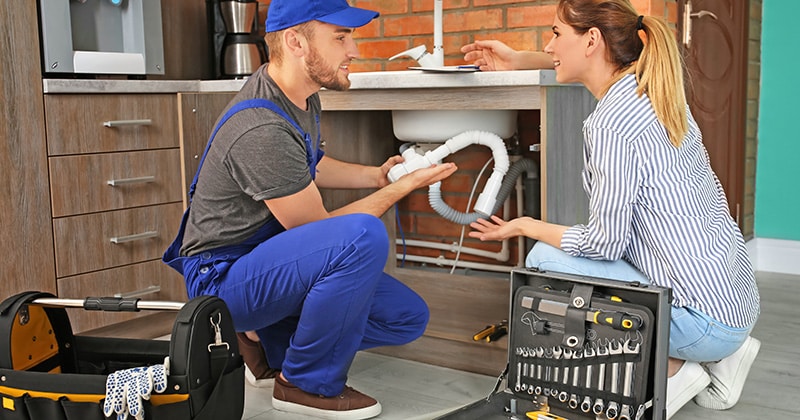

Customers always want a versatile, well-rounded plumber. Whether it’s a late-night leak, a stubborn sink clog, or a full system installation, clients expect one professional who can do it all.
Your success could very well come down to the list of plumbing services offered. A broader service portfolio means more work and more revenue. So, why limit yourself?
This guide breaks down the plumbing services list for contractors. Read on and learn the essential services you should be offering to remain competitive and profitable.
RELATED ARTICLE — How to Effectively Manage Your Plumbing Company
Complete Plumbing Services List
Plumbing services include emergency repair, fixture/appliance installation, piping work, inspection, and ongoing maintenance. And keep in mind that full-service plumbers work on both residential and commercial properties.
Below is a comprehensive list of a full-service plumbing company offerings. Bravo if you can tick most of these:
- Pipe and line services: Water line installation, repiping, pipe repairs, and descaling
- Fixtures installation: Fixing and installing faucets, sinks, showers, toilets, bidets, and bathtubs
- Appliance installation: Setting up and repairing appliances such as dishwashers, garbage disposals, and washing machines
- Inspection: Checking plumbing for leaks, clogs, potential weaknesses, and other faults
- Sump pump services: Installing, repairing, and testing sump pumps
- Gas line services: Installing and ensuring the safety of gas lines and gas-powered appliances
- Water heater services: Setting up and maintaining hot water systems
- Water quality solutions: Installing and servicing water purification systems such as filters, softeners, and sterilizers
- Drain cleaning: Removing stubborn blockages and buildup to ensure full flow in pipes and sewer lines
- Emergency plumbing: 24/7 on-call response to plumbing emergencies (severe leaks, sewer backups, burst pipes, etc.)
- Specialty plumbing: Plumbing services for unique applications such as construction, irrigation, hydronics, commercial water treatment, and industrial plumbing
Core Plumbing Services
Most plumbers focus on services that meet the most common customer needs. These are the core plumbing services. They center around installing, repairing, and servicing plumbing systems.
As much as you’d want to diversify, it’s also important to cover the basics. What’s more, those “basic” services are the bread and butter of the plumbing business. The bulk of plumbing work comes from three common plumbing services categories.
Plumbing Installation Services
Every new home, office building, school, hospital, or restaurant needs running water. That’s where plumbing installation services come in. A professional lays all the new pipes, installs the fixtures and appliances, and hooks everything up to the water and drain lines.
Plumbing installation is not just in new constructions either. During a remodel, the job may require a plumber to move some things around. Partial installation may involve fixing a faucet here and there or re-routing some pipes.
Plumbing Repair Services
Plumbing repair simply means fixing problems on existing plumbing systems. Pipes, drains, sewers, gas lines, fixtures, and appliances go wrong from time to time. So, repair services are revenue generators that just keep on giving.
Besides, you’re more likely to get calls for repair jobs than full installations. And repair jobs are often where plumbers get to showcase their skills and competence.
Here is what a typical plumbing repair services list looks like:
- Leak detection and repair
- Unclogging drains and sewer lines
- Repiping
- Plumbing fixtures and appliances repair
- Low water pressure fix
- Repairing and relining water pipes
- Plumbing overhaul and restoration
Plumbing Maintenance Services
Plumbing maintenance or service is closely related to plumbing repair. However, there’s a distinct difference. While repair focuses on fixing issues, maintenance is all about keeping plumbing systems running smoothly. Maintenance essentially prevents problems that might need repairs.
It’s similar to how you take a car in for servicing. You don’t do it because the car is broken, but to keep it healthy and extend its life.
Maintenance work is a great source of recurring revenue. That’s because you can lock in long-term clients using service contracts. Such contracts are especially popular among commercial clients with high-stakes plumbing systems.
Plumbing maintenance services include:
- Scheduled full system inspection
- Sump pump care
- Seasonal pipe insulation
- Pressure monitoring
- Gutter and drain cleaning
- Plumbing appliances servicing
- Planned system flushing
- Stress-testing critical components
RELATED ARTICLE — How to Get More Plumbing Leads for Your Business
Residential Plumbing Services
Residential plumbers deal with the installation, repair, and service of domestic plumbing systems. This includes the pipework, fixtures, and appliances in homes and apartments. Most residential plumbing services are pretty standard and straightforward.
The residential sector holds the lion’s share of the plumbing market. And it’s easy to see why. The country’s nearly 150 million housing units create a strong demand for plumbing services. Not to mention that new houses are constantly being built.
But what does this mean in terms of the services offered?
Well, here’s a comprehensive residential plumbing services list:
- Full and partial plumbing installation
- Fixtures installation and repair (faucets, toilets, showers, bathtubs, etc.)
- Appliance hookups and repair (dishwashers, washing machines, water heaters, etc.)
- Gutters, drains, and sewer line servicing
- Gas line services
- Toilet and bathroom re-dos
- Sump pump services
- Water quality and safety services
- On-demand repairs (unclogging drains, replacing damaged pipes, fixing leaks, etc.)
Commercial Plumbing Services
Commercial plumbing work deals with large-scale or specialized plumbing systems. These are plumbing systems for business establishments such as office buildings, hotels, hospitals, and factories. The services range from custom installations and compliance work to service contracts.
What makes commercial plumbing different from residential plumbing is not just scale. Commercial systems are also more complex. In fact, some systems, like those in industries and healthcare, are designed for very specific functions.
Let’s break down the commercial plumbing services list.
Large-Scale Plumbing Installation
Commercial plumbing systems are often much larger than their residential counterparts. Obviously, larger buildings require more pipes, fixtures, and appliances.
And not just the sheer quantity, but most components are super-sized. We’re talking, for instance, wider main water and drain lines and high-capacity valves.
Naturally, commercial plumbing installations tend to be more complex too. They may involve specialized tools, collaborations with other contractors, and prefabricated components. Plumbers will often break large projects down into phases or stages to simplify management.
Compliance Assurance
When it comes to commercial plumbing, there’s quite a lot at stake.
Take a high-rise office block, for example. The plumbing system plays a crucial role in the health and safety of hundreds of workers. The same is true for places like hotels, hospitals, and schools.
That’s why commercial plumbing is subject to rigorous health and safety standards. Good examples of these are the Uniform Plumbing Code (UPC) and the International Plumbing Code (IPC). These codes and other guidelines ensure that plumbing systems meet acceptable quality and safety requirements.
It’s the plumber’s job to make sure that every commercial installation is compliant. Compliance assurance mainly comes down to using the recommended plumbing materials and methods.
Plumbing Service Contracts
A service contract is a binding agreement between a plumber and a client. It seals a commitment for ongoing plumbing maintenance and servicing.
You’ll mostly get these with commercial clients. That’s because commercial plumbing sees plenty of action. Therefore, a lot of care is needed to keep everything running smoothly.
Specialized Plumbing Services
Some businesses or establishments have rather unique plumbing requirements. There are scenarios where plumbing goes well beyond running water and drains.
Think about the sort of plumbing in a sugar processing plant, for example. Of course, you’ll find toilets and faucets, but also sophisticated water and steam systems weaving between the various machines.
Let’s look at some examples of specialized plumbing services:
- Large-scale water conditioning and purification
- Mechanical plumbing
- Medical gas piping
- Fire sprinkler service
- Flood management
- Expert witness services
- Agricultural plumbing
Emergency Plumbing Services
Emergency plumbing services offer 24/7 rapid response to plumbing issues. Technicians rush to sort out potentially dangerous plumbing emergencies. The emergency could be a burst pipe, flooded basement, sewage backup, or gas leak.
“Emergency plumbing response” does sound like a cheesy marketing ploy. How often do these “emergencies” really occur?
Actually, all too often.
According to research, 70% to 80% of plumbing services are considered urgent.
When someone calls you for help at 3 a.m. ankle-deep in water, you better say, “On my way.” Otherwise, you might lose some credibility as a plumber.
Besides, emergency services are about preventing damage to property and infrastructure. Your quick action may even prevent injuries or save lives.
So, in addition to driving quick bookings, emergency plumbing services are critical.
Preventive Maintenance and Inspection Services
Preventative maintenance services are proactive actions meant to prevent damage to plumbing components. They include periodic inspections, minor fixes, and general servicing. The idea is to keep everything peachy and avoid costly repairs in the long run.
Clients expect plumbers to provide proactive maintenance. Commercial systems in particular require a great deal of care.
Here’s a quick overview of what preventive maintenance looks like:
- Regular inspections: Check all plumbing systems routinely for leaks, damage, or wear.
- Drain cleaning: Remove debris and gunk buildup in drain lines.
- Valve maintenance: Test shut-off and non-return valves and re-grease as needed.
- Winterization: Insulate exposed pipes during winter to prevent freeze-related cracks and clogs.
- Pipe care: Prevent and repair cracks, bottlenecks, and corrosion in pipes.
- Water heater maintenance: Flush the water heater regularly and check its valves, thermostat, and heating elements.
- Component replacements: Replace components that show early signs of wear or damage before they actually fail.
Offering these services helps you build recurring, long-term revenue. It also opens up new marketing and growth opportunities.
High-Value and Add-on Plumbing Services
High-value and add-on plumbing services are high-margin offerings that go beyond typical plumbing. These services range from luxury upgrades to tech installations. They are designed mainly to enhance the plumbing’s quality and the property’s value.
Let’s look at some of the add-ons you can upsell to your customers:
- Water filtration systems: Install high-end filtration systems to enhance water quality.
- Sewer camera inspections: Use cameras to survey drains and sewer lines for hidden defects or damage.
- Repiping projects: Offer pipe replacement services, especially for outdated galvanized or polybutylene pipes.
- High-efficiency fixtures: Upsell water- and energy-efficient fixtures such as aerators and low-flow showers.
- Kitchen and bathroom upgrades: Sell the idea of remodeling kitchens and bathrooms with modern fixtures, pipes, and appliances.
- Smart plumbing tech: Promote smart plumbing gadgets such as automatic faucets, tankless water heaters, and smart meters.
How to Package, Price, and Manage Plumbing Services
Package and price plumbing services in a way that shows value and drives profits. Frame your services as solutions rather than work hours. Set reasonable price points that are both competitive and profitable too.
Packaging Plumbing Services
Packaging plumbing services is pretty straightforward. Just call it like it is.
Start by listing all the services that you offer. Then group related services together. For example, a full installation can be a package on its own. And ongoing maintenance can include services like drain cleaning, inspections, and pipe care.
You can also have custom packages to fit unique customer needs. Allow customers to choose services from your portfolio and have them delivered as a package.
How to Price Plumbing Services
Pricing plumbing services can be tricky. You want to find a balance between profitability and competitiveness. At the same time, you don’t want to undersell your value as a plumber. That’s a lot to juggle every time you quote a plumbing job.
Generally, there are two ways to price plumbing services:
- Time-and-materials pricing
This approach charges customers for materials and labor. It’s normally used for large or complex projects with unclear scopes. This is where you’re not sure how long a job will take or how much it will cost.
- Flat-rate pricing
With flat-rate pricing, the customer pays a single, predetermined fee. This should, of course, cover the cost of supplies and overheads and leave enough room for markups and profit.
Many plumbers prefer flat-rate pricing for its simplicity. You’ll find that most clients are happy with it too. They know exactly how much to pay right from the start.
Either pricing method can work, depending on your business model. Though, pricing is not just about picking a pricing model. The trick to pricing plumbing services is having a firm grip on costs and value. In other words, ask for what the service is worth without sacrificing earnings.
RELATED ARTICLE — What Is a Flat Rate Price? (and Should You Offer It?)
The Secret to Managing a Plumbing Business
Running a plumbing business is no easy task. You have to manage clients, crews, services, and finances at the same time. It can all be too overwhelming.
The good news is that digital tools can make your job a lot easier. A robust field service software like Service Fusion is all the help you need to run the business. It takes the guesswork out of estimating, billing, scheduling, dispatch, and customer management.
Service Fusion is designed for contractors looking for efficient ways to run and grow their trades. Request a free demo today and see for yourself.
Related Posts
How Kuhlman Electric Found Their Field Service ‘Game Changer’ and Doubled Revenue
Continue ReadingHow to Reduce Idle Time for Field Service Technicians
Continue ReadingStay Informed
Get the latest news and insights plus, Service Fusion offers and updates.Thank you for your submission.
SHARE