
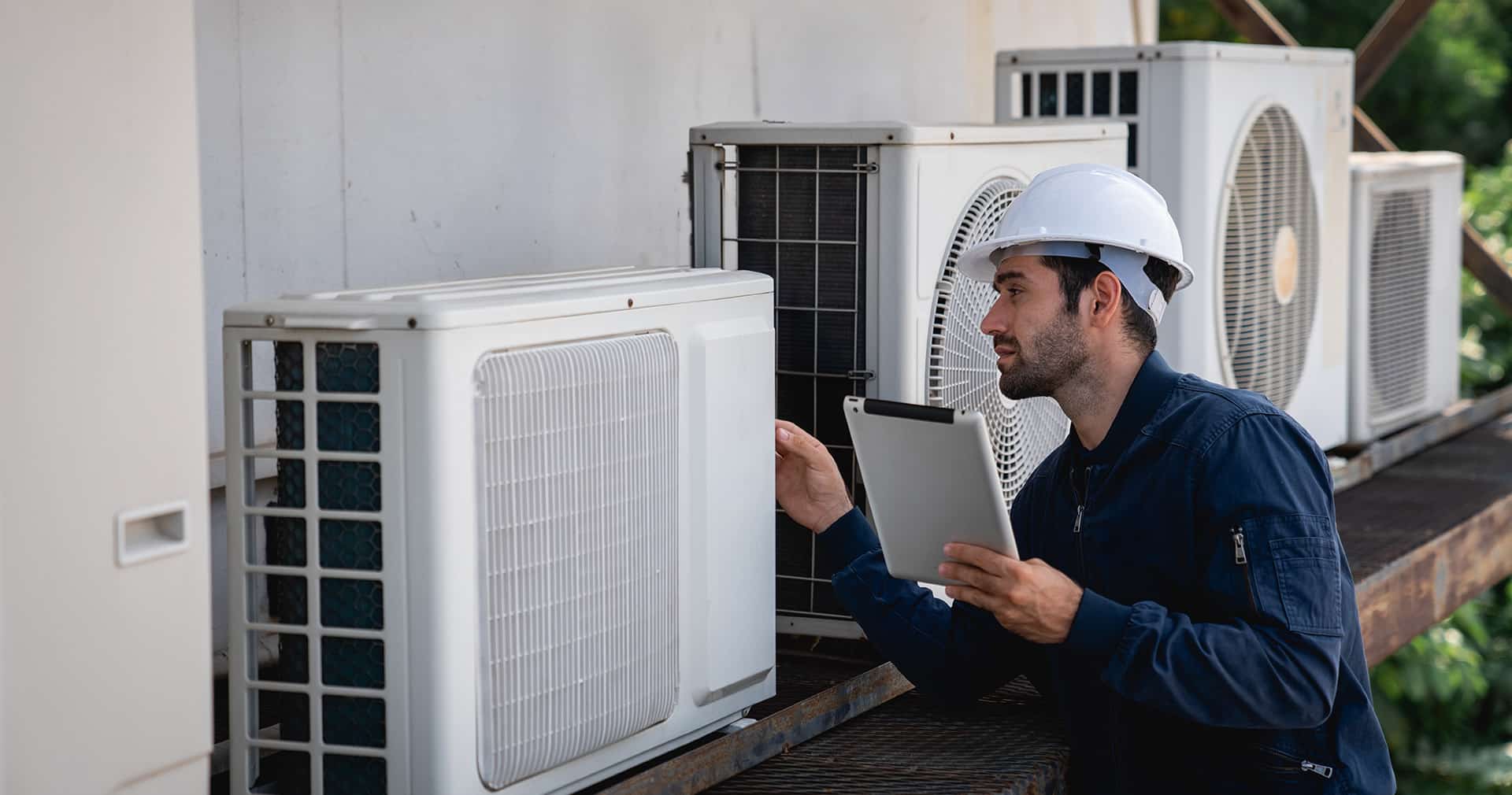

No matter what stage your business is at, your HVAC services list always has room for growth. This revenue-focused guide groups services into categories. You can use them to find new opportunities.
Learn the core HVAC services all companies should offer. Plus, get add-ons and specialties for residential and commercial customers. Read advice on how to package additional services to upsell. And read how software for HVAC professionals helps you pull it all together.
Complete HVAC Services List
We’ll go into more detail on these items in the sections to follow. But first, here’s a list of common HVAC services offered by contractors:
- Central heating system installation and servicing
- Central cooling system installation and servicing
- Ductless mini-split installation and servicing
- Window unit AC and evaporative cooler installation and servicing
- Air quality control (duct cleaning and air purification/filtration)
- Ventilation system installation and maintenance
- Programmable thermostat installation
- Zoned heating and cooling system installation
- Smart HVAC system installation and upgrades
- Energy efficiency and climate control consultations
- Humidifier and dehumidifier installation and servicing
- Refrigeration system installation and servicing
- HVAC system inspections before property sale
- Boiler and pump system installation and servicing
For each of these services, you may work with residential and/or commercial clients. You might also offer emergency services for some, like furnace and AC repair.
RELATED ARTICLE — How to Start an HVAC Business Today
Core HVAC Services (Installation, Repair, Maintenance)
At the top of the HVAC services list for contractors are core offerings. They are services that every company should promote. They include installation, repair, and maintenance of heating and cooling systems. This is the bread and butter of most HVAC contractors.
What’s on that list specifically?
- Installing, repairing, and performing maintenance on furnaces and heaters
- Installing, repairing, and performing maintenance on cooling systems
You’ll need to know how to work with gas- and electric-powered furnaces. Your business should work with central and window air conditioning too.
You should also know how to handle mini-splits and wall heaters. These are popular in warm areas and in home additions with no ductwork.
There are regional systems you may need to know if you work in certain areas of the country. In northern cities, like Chicago and New York, many properties use steam radiators. In the Southwest, you’ll find swamp coolers. These evaporative coolers cool the air by adding moisture to it.
Residential HVAC Services
Your residential HVAC services list should include all the items listed above. Most HVAC companies also offer emergency repairs for heating and air conditioning. This is essential for homeowners during cold snaps and heatwaves.
The demand for services to improve indoor air quality has been growing over the last few decades. But air purification and filtration became much more important during the pandemic. It’s great to offer service in this area for:
- Families with young children
- People with allergies
- Houses with pets
- Homeowners who want to reduce dust
Related to this is house ventilation. It includes fans, intake valves, and registers related to heating and cooling. You can improve airflow and utility efficiency by understanding how ventilation systems work. And ventilation is a key component of air quality improvement.
Commercial HVAC Services
Working with businesses can boost your bottom line. They bring in higher-paying projects and can offer steady contracts. What should be on your commercial HVAC services list?
You should be able to work on commercial heating and air conditioning systems. Most are large-scale versions of residential systems. But they typically involve more complex ductwork.
You may also work on commercial boilers and pump systems. This depends on your location and the type of clients you serve. These systems supply hot water, heating, and cooling to apartment buildings and offices.
If you partner with a property management company, you can often find a steady source of income. You might wind up working on residential properties, like apartments, or offices.
There are lots of different types of commercial properties that need specialized HVAC:
- Retail properties
- Industrial facilities
- Educational institutions
- Hospitals and clinics
- Restaurants
If you can find a niche with one or two of these, you can become the experts people call for help.
Speaking of restaurants, many HVAC companies also service commercial refrigeration systems. They’re used in hotels, restaurants, and commercial kitchens. Most of the technology overlaps with heating and air conditioning. So it makes sense to learn this as well.
One way to cement ongoing commercial work is to offer annual service contracts. These usually include biannual service calls to keep everything running smoothly. They’re also attractive because:
- Customers don’t have to remember to call you for checkups.
- Service contract holders get priority on the calendar for emergencies.
- Clients may get a discount for parts or large upgrades.
RELATED ARTICLE — HVAC Technician Certification
Preventive Maintenance and Service Plans
You can offer service plans to residential customers too. In fact, it’s a great way to drive consistent revenue and get repeat business. After all, you only charge once for a furnace repair or AC system installation. But maintenance jobs give you regular income and build long-term customer relationships.
The customer usually pays twice per year for maintenance—a bit like getting a tune-up on their car. You make sure all their systems are operating properly before major seasonal changes.
Furnace maintenance is a safety issue as well as a convenience. Carbon monoxide is a byproduct of the combustion that occurs in furnaces. And every year it hospitalizes and kills hundreds of people.
Record high temperatures have been occurring across the US lately. So ventilation and air conditioning are also safety concerns. Heat-related deaths are a particular worry with babies and the elderly. But inadequate indoor cooling can affect anyone during a hot spell.
What should be on your HVAC maintenance services list?
- Furnace, boiler, and duct inspection
- Air conditioning unit inspection
- Testing ignition, switches, and motors
- Replacing faulty electrical components
- Changing air filters
- Calibrating the thermostat
- Checking blower function
- Cleaning and removing blockages
- Assessing pumps and cooling towers
High-Value and Add-On HVAC Services
Full service HVAC company offerings can go a long way in adding value for your clients. And having a large menu of services is good for steady revenue.
The most successful HVAC businesses upsell or cross-sell other services. What are some you could add for your clients? Most of these apply to both residential and commercial HVAC:
- Duct cleaning to remove blockages and improve air quality
- Adding air quality solutions to reduce allergies and airborne illness
- Installing programmable thermostats for energy efficiency and savings
- Upgrading with zoned heating and cooling in different parts of the house
- Installing smart HVAC systems for convenience and green living
- Installing humidifiers or dehumidifiers for whole-house moisture control
- Providing energy efficiency and climate control consultations
You could also perform HVAC inspections for home buyers before they purchase properties. Home inspections don’t typically include a thorough HVAC evaluation. But you are able to provide as a specialist. One way to get more of these jobs is to collaborate with area real estate agents.
How to Package and Price HVAC Services
Your company should have two revenue goals when servicing customers:
- Increase ticket size with add-on services.
- Keep clients for future business.
So, how you bundle and price your services can help you achieve those goals.
Say you call on a customer to repair their central air conditioning system. You could offer to come back in the fall to make sure their forced air heating is working correctly. You could package this with an AC maintenance call the following spring.
Or you could offer duct cleaning when making an appointment for furnace maintenance. Similarly, pairing air filtration with an AC tune-up can net more income.
You can offer a slight discount when customers add on a service. You’re making more money in total, so you can absorb the lower price.
Other ways to get HVAC customers to add services include:
- Offering time-limited seasonal maintenance specials
- Adding items to client annual service contracts
- Giving customers data on the benefits of upgrades
- Providing low-cost energy audits for potential savings
Ideally, you want customers to return to you several times a year for their HVAC needs. They don’t want to wait until something breaks to call. You can show them it’s more cost-effective to perform routine maintenance than to deal with an emergency.
Word-of-mouth referrals can be as valuable as repeat business. Consider offering customers a discount for referring you to a new customer. They may have a family member or neighbor who also needs HVAC services.
And always ask customers for an online review if they’re happy with your service. Text and/or email the link where you want them to leave the review. That makes it a no-brainer while their satisfaction is still fresh.
RELATED ARTICLE — Build Lasting Customer Relationships for Your HVAC Business
How to Expand and Manage HVAC Service Offerings
Your HVAC repair services list and installation offerings should change with the times. And as your business grows, you can learn new specialties and techniques. You want to offer new services when they come to market to keep up with the competition.
You don’t have to provide every service discussed above when you first launch your business. But it’s good to have a plan for adding new services every six months or so.
That means having a marketing campaign and tracking customer leads over time. It’s easy to do with software tools for field service professionals like Service Fusion.
This platform lets you manage customer relationships online. There’s no more old-fashioned pens and paper. And say goodbye to losing clients because you forgot about them in the sales funnel.
Plus, improve productivity and get paid faster with features like:
- Scheduling and job assignment
- Routing and dispatch
- Job status tracking
- Customer history and past jobs
- Online payment acceptance
- Project estimate templates
- Flat-rate integration for parts
Your customers will be happier, and so will you and your employees.
Ready to see how Service Fusion would work for your HVAC company? Book a demo today.
RELATED ARTICLE — How to Value an HVAC Business: Proven Methods and Examples
Related Posts
Best Field Service Software for Businesses With 5 to 20 Technicians (2026)
Continue ReadingField Service Software Data Migration Checklist
Continue ReadingStay Informed
Get the latest news and insights plus, Service Fusion offers and updates.Thank you for your submission.
SHARE